
Taxi for cash!
[Dave Birch] Some years ago, Ronnie O'Toole from the Central Bank of Ireland was kind enough to come along and give a talk at our annual Forum in London. Apart from the fact it was a terrific talk in all respects, I always remember it because he brought up the topic of taxis as a benchmark for cash replacement and this struck me at the time as the perfect prosaic platform to assess the evolution of alternatives. As anyone who reads this blog will have noticed, I've continued to annoy taxi drivers around the globe almost continuously since then. I'm writing this in a Florida hotel room and I paid the taxi to get here using a card. Admittedly, the driver took the payment using a circa-1959 zip-zap machine, but hey, at least I didn't use cash.
As was discussed back at the Digital Money Forum, after an excellent presentation by Ronnie O'Toole from National Irish Bank, a significant step toward cash replacement would be for taxi regulators to insist that cabs take contactless. This was part of the bank's submission to the Irish Department of Finance: "The taxi regulator should make it compulsory for all taxis and hackneys to accept payment by debit or credit cards by the 1st of November 2008".
[From Digital Money: User inexperience]
They didn't, as far as I know, but I'm happy to report that when I jumped in a cab to go and listen to Ronnie (amongst others) at the International Cashless Society Roundtable (ICSR) 2013 in Dublin, not only was I able to pay by card, I was able to pay by card to the driver's mobile phone! I knew Ronnie's benchmark was good one. Taxis that don't take cash are the hallmark of a civilised society.
We didn't spend too much time on taxis as a specific sector at the round table, but we did have a series of genuinely interesting discussions -- many of them grounded in the new Irish National Payments Plan -- about the steps on the road to a cashless society. This is taken very seriously in Ireland because the payment system is particularly inefficient, with high levels of cash and cheque usage. Ronnie had just written an article about this for the Central Bank of Ireland Quarterly Bulletin (it's "The Usage, Cost and Pricing of Retail Payments in Ireland" on page 74), and he explained the problem in some detail.
Ireland has the second highest usage of cheques in Europe, the highest ATM withdrawal per capita and still pays out half of all social welfare payments in cash. Cheques are a very expensive form of payment, and much less efficient than debit cards. Ireland could save up to €1bn per year by migrating to more efficient payment instruments. One impediment to a faster migration is that the pricing of payments in Ireland is not commensurate with the cost of provision.
I think this is a particularly important point. It came up on the lobbyists panel at the CNP Expo in Orlando this week as well and I'll blog more about it when I've got time. Ronnie had some numbers to hand:
Only 46% of the costs of providing cash and cheques services are recouped by banks, with significant cross- subsidisation at the expense of electronic payments… Banks in Ireland suffered combined losses of €172m in the provision of cash and cheque services in 2009, which were largely offset by their highly profitable credit card business, which showed a profit of €140m.
The efficient electronic payment systems are being forced to subsidise to inefficient paper payment systems. Why is this allowed to continue? Surely it should be a goal of any national payment strategy to reduce the use of cash and cheques in favour of electronic alternatives and not, as Chancellor George Osborne advocates, leave cash alone and make cheques clear slightly quicker. If people want to carry on using cash and cheques then fine, but make them pay for it.
To the argument that "well, it's poor people who use cash so if you increase the cost of cash you will punish the poor" I say this: people who are trapped in the cash economy already pay far higher transactions costs than people who are not.
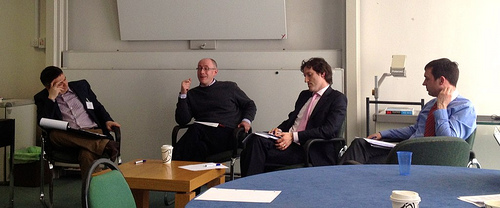
I really enjoy this kind of event: real experts taking part in real discussions. I felt that I learned something from every exchange. So many thanks to Dr. Fergal Carton from the Financial Services Innovation Centre at the University College Cork for pulling it all together. I'm looking forward to the 2014 event already.
These are personal opinions and should not be misunderstood as representing the opinions of
Consult Hyperion or any of its clients or suppliers
Comments
License

The English language version of this work is licensed under
Creative Commons Attribution-ShareAlike 3.0 Unported License.
If you wish to acquire the rights to make a foreign language translation of the work, please contact Consult Hyperion.
Please note that by replying in this Forum your comments become the property of Consult Hyperion and you assign all rights in your comment to us. Your comments may be edited for length and used online and in print but will always be attributed.
Meet us at:






Blog Categories
Blog Archives
- August 2013
- July 2013
- June 2013
- May 2013
- April 2013
- March 2013
- February 2013
- January 2013
- December 2012
- November 2012
- October 2012
- September 2012
- August 2012
- July 2012
- June 2012
- May 2012
- April 2012
- March 2012
- February 2012
- January 2012
- December 2011
- November 2011
- October 2011
- September 2011
- August 2011
- July 2011
- June 2011
- May 2011
- April 2011
- March 2011
- February 2011
- January 2011
- December 2010